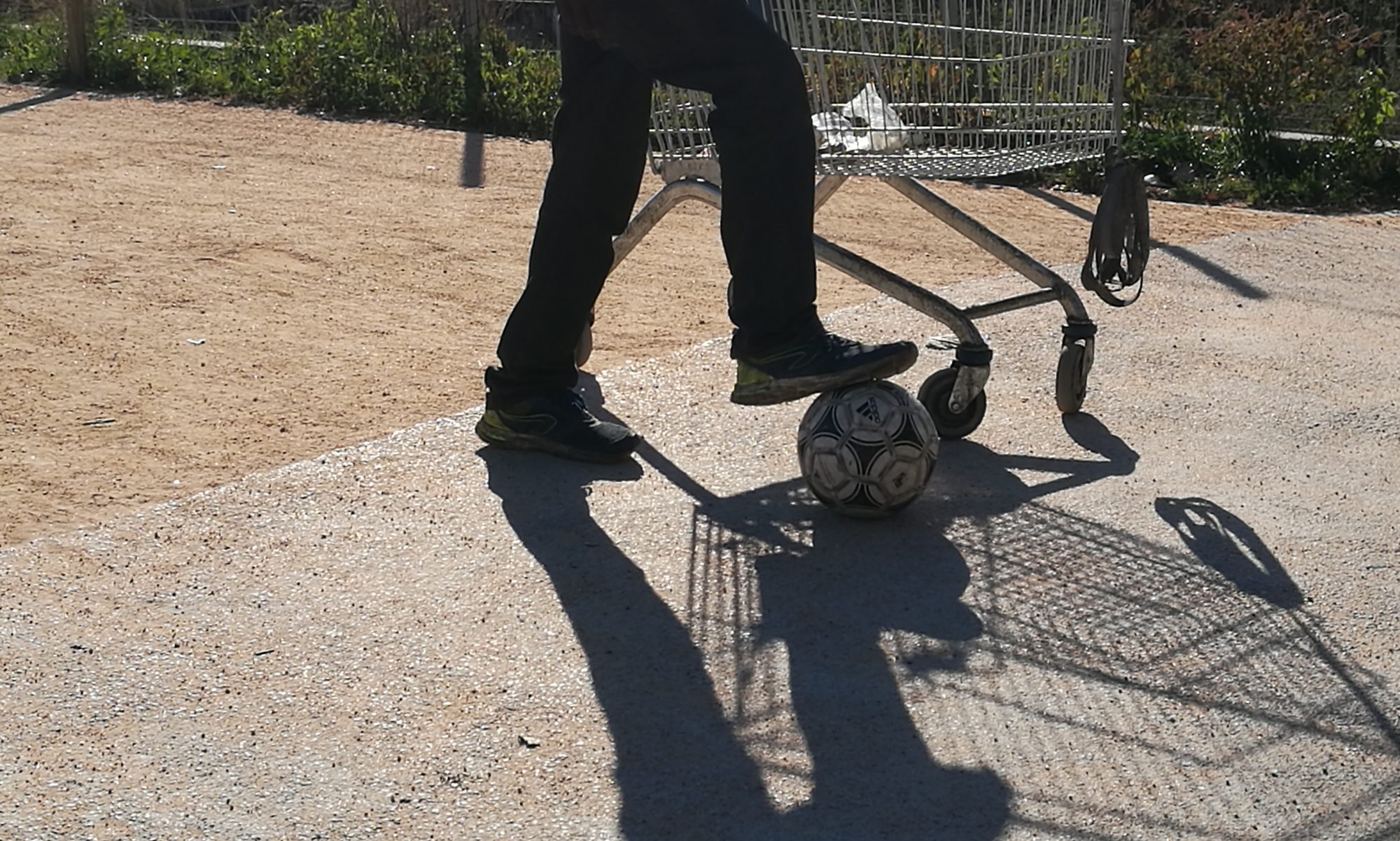
Walking and talking

An introduction to the walking podcast

Talking the walk and walking the talk

«At the same time, he says, unlike the strolls you are reduced to taking in a city like Paris or New York, you can walk at a decent pace in the London parks and on the London heaths, at the sort of pace that gets the blood flowing and there is nothing more conducive to good talk thatn the healthy flowing of the bood in the veins and a decent walking rhythm»

Moo Pak, Gabriel Josipovici

For quite some time, I’ve made walking a relevant aspect of my routine. Moreover, these walks have represented a way in which I could also improve the mental thought that pops up in any given walk you take. But explicity so, I’ve made a format that includes recording a podcast as the ultimate conversation within yourself, as an exploration to dedicate this thought to align the elements that converge between my current internal journey, my external interaction with society, as I walk to places where I’m suppose to go.

So when I go to work, in the time it takes me to go from my home to the bus stop, which is around 9 to 15 minutes, I launch another session of the Walking Podcast. «Hello, this is Golman, and welcome to another episode of the Walking Podcast. Talking the walk and walking the talk.» That’s my entry line in every episode. Then there’s nothing but the string of thought that comes with the day. This is no other that an immediate connection with the moment. Each step at a time. It’s a certain way to address that I am here, alive, and in this simple gesture, I will align myself with my inner forces to make of this day one that counts.

So that’s what I do. And they all turn out to be versions of the same conspiracy: what if we all could be actors of revelation of NEW collective framework that enables us to become active actors or a greater, fairer, gentler version of our humanity? What will it take for a collective instruments and mechanisms to bring out this emergent structure to reflect on change, impact and tranformation of our global ecosystem?

Yet, Jack Toledano talks about another type of walk. One you make with another person, to strike a conversation. I agree. That’s the most sympathetic way of striking a mood for the direct interaction between two people. The way in which you connect with other, by interacting with what’s in stake, whatever subject pops ups, that requires the immediacy of a response, and the pause and attention of a good listener, and the iteration of evolving feedback.

I’ve practiced those walks. I’ve been exploring the transit of my city, Barcelona, in order to understand the unfolding of each journey and pathways that interconnect the diversity of borroughs, as I understand that walking here is as rich as walking through London parks. It’s not a walking competition, but I’ve managed to do so by allowing myself to be doing those walks as an exploration of my surroundings, at first, and then as a possibility to show others that journey, with the sense of discovery and companionship, that one gets by simply breaking down through unchartered territories. And there, in those walks, the talks and conversations gain a new dimention.

Nietzsche perhaps overdid it, he says, as he overdid everything, in his insistence that the only thoughts worth preserving are those that come to one on walks and in his conviction that what was wrong with Descartes and Kant was that they refused ever to get off their backsides.

While Jack Toledano has something clear: «I personally, Jack says, don’t know what it means to think, either walking or sitting, but I know that the only way I can make anything that will cause other to think is sitting at my typewriter at my desk and the only way I can talk is walking.

The walking podcast

Letting go to find the literature within your head

«Writing, he says, is a means of escape from the self as well as a means for discovery»

About Jack Toledano way of writting. Moo Pak, Gabriel Josipovici.

Writting. That’s the act. If one writes something is expressed. Good, bad, who cares. Writting takes you places. You may not know where it will end. But it triggers something that you don’t realise until it’s been written. And there’s no other way. It needs to come out a stream of conscious tought that is being spilled somewhere. That kind of freedom is what Jack Toledano is talking about when whe says this to the narrator of Moo Pak. And I couldn’t agree more with it.

Nevertheless, he goes on to rant against handwritting or using word processors in a way that he describes asn inhibitors of this freedom to let go. It cannot be done, he says. Or at least he exposes that it’s not availbe to him. As the little humming noise on the electronic typewritter and continuos glow of the red light that turned on to signal acusssingly his pauses when he stayed still for a moment to think between each moment of clear writing impulses.

Format and working mechanisms are for each to shape into our own way of delivering what it is we want to do. The creative process, in a broader sense than just writing could allow many other formats to produce some sort of spell that represents the artistic form and shape of the piece that encapsulates the profound meaning of our art. While I have explored many formats, I respect the people that find the clear pathway of a specific format that produces the results they are satisfied with. And I’ve also encouraged the transition from different formats to force myself to deliver the equivalent liberation at different wavelenghts of my own developement as a creator. This to me has represented new pathways to find myself in unexpected places I would have not imagined to reach if I had not turn to that spell, with those new tools, rules and mecanisms to follow through.

And eventualy, too, to break.

Jack Toledano says you can’t let go with a pen or a word-procesor. I believe you could. But then he also talks about a little conforence in London with Borges, where Q&A were addressed in written form for him to be read, so that he could say which one he would answer. Why don’t you write about women? If it was because he didn’t think of them. He said that’s why he writes, so he wouldn’t be thinking about them all the time. And that’s were jack Toledano finds the reason and importance of writting: escaping from a daily nimeous routines: «That is why a pean or a word-processor is no use, Jack Toledano said that day on Hampstead Heath, with a pen or a pencil you cannot escape yourself and your fantasies and why else does one write if it is not to escape from the prision-house of the self and its banalities?«

«Pens are for Victorian novelist, he said, and word-processors are playful post-modernists»

I guess I would be the in between of all those fools…

On writing from the top of your head

Study on Moo Pak, by Gabriel Josipovici

By Golman

«Only the last paragraph can tell you whether you’ve got the first paragraph right, he said, only the last word can make sense of the first.»

Gabriel Josipovici, Moo Pak

I was handed this book yesterday by Ferran Ràfols, who’s the translator of the book to catalan. The book is signed, and while he thought he had another copy of the book, he didn’t so he made sure to clear things up: «Ei, when you send me that message yesterday, and from the talk we had the other day, I remember I told you about this book. But, bear in mind that I thought I had too copies, but I don’t, so I want I will need it back».

Fair enough. Clarity is very relevant to build trust among people. Besides, I told him that this sort of thing would inspire me to see how to extract from this reading my own personal notes given the circumstances where I will not be able to mark the pages, and doodle the margins with those sactions of my thoughts that populate my persona library, and that are there quitely waiting for me to back to them, and make something out of them.

This way, I’ll be forced to do something else. And this text is what I’ve figured out to produce in order to extract the knowledge from this recomendation, in a time where I’m trying to find myself the vehicle to kick start a narrative with my name on the cover.

So here we are, a couple of pages in, and already get anxious from leaving stuff behind that I wish I would have made a note on. The fact is that the conversation that the narrator is having in the very first page of the book binds me to the idea that I will encounter a place where I will be drawing some lines that connect my mind with both the characters and the author. And I will be pursuing the reverse engineering of a creative process that expells my own demons towards the pages of voices that reasemble the structure of my desired tales. This long battle within.

So I stumbled upon this quote, and I thought about using this format. Other format would have been to make an ilustration, like all those that are stacked within the pages of my notebooks. That’s certainly a way to go about it, but I’m going to take this path of writting it directly in my page, as the narrative is exposing just the opposite of my own process, in at least two ways.

First, the narrator explains that he has given up writing by hand. I actually, a few year back, did the reverse move: I went to handwriting in order to find the expression and tension of my caligraphy, and to be bound to measure of the page, the spaces between the top of the page, the size of my lettering, and the purity of my stroke. While the character gave up writting in order to explore type writting. That is to use a classic Olivetti that could allow him to se the words coming out the page, but also be limited by the capacity of blank sheet of paper. The written printed words out there. From the very beginning. It’s clearly an appealing feature to write and get it right. So he goes about the way in which in order to do so, he has the capacity to keep going, until he gets to the end. And once printed, or once he’s found the mistaken word, sentence of paragraph, starting over from the top of the page provides a second exercise of getting close to the truth. As you copy your own words, but now out of the printed version, the formality and decisiveness of that text no longer presents the doubts those same words bare when they were being thrown into the page. And that’s a beaufiful step forward that I need to revisit as in my personal struggle I need to jump into a new phase: re-reading my own texts and editing them to finally get the worked out version of what I really want to share with the world.

So while his friends insist that the new thing would be to use text processor, from an Apple or a Mackintosh (that provides a clue as to when the character is dealing with this issue), he rather stays within the realm of the typewritter structure, that allows him to go page by page.

At some point I took that detour too. I stopped using word documents to shift-up towards the publishing bit of an online wordpress format. More like the friends of the narrator, I was propelled of the word document to try to get something out there, and the word files were pilling within the folders of oblivion.

So this too is a tension point between Josipovici’s approach and my own. And this how I will intend to find the common links and bridges from my own mindset to his own. And I am using a relevant messenger to transpose these two worlds: Ferran’s advice to do so.

And I’ve made up my mind just now: instead of going on and on, I’ll stop here and work out a single text, as short as around nine paragraphs would allow, to extract a written effect from a quote from Moo Pak. This is my new format. This exercise will allow me to unleash from my own gatekeepers.

ALLS